

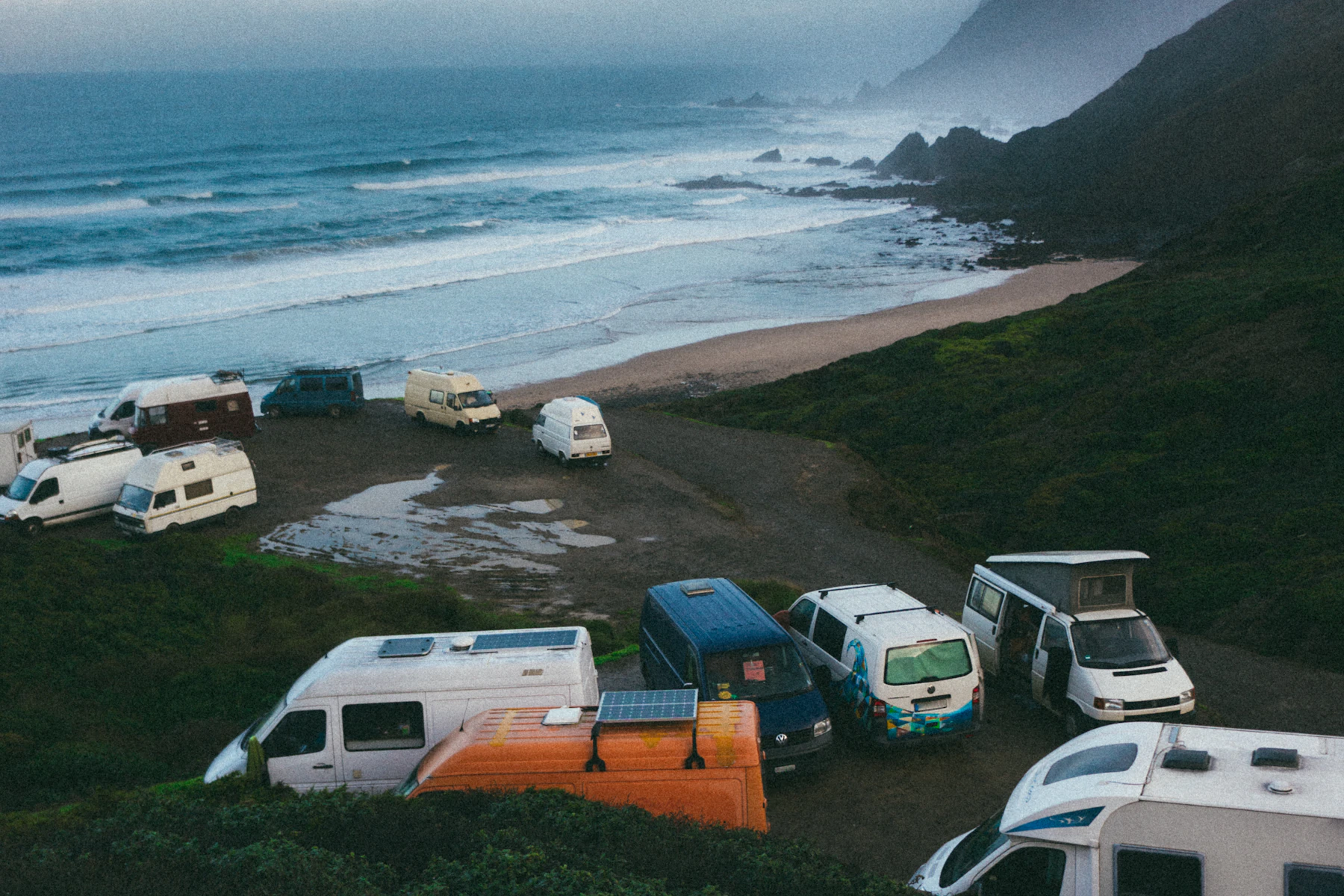
Most first-trip trouble in Europe comes from six assumptions, and all six are reasonable if you have only ever camped in one country.
1. Assuming there is a European rule
There is no EU camping law. There is no continental default that a country departs from. Each country builds the rule out of different legal parts, and the parts do not line up.
A short tour of how different the shapes are:
- Scotland grants a statutory right of responsible access, and it covers lightweight camping in a tent, in small numbers, for two or three nights in one place. It does not cover camping from a vehicle. See the Outdoor Access Code.
- France distinguishes bivouac from camping sauvage, and the distinction decides what is legal. Bivouac is a walker’s permission over a single night in a basic setup, and several national parks explicitly exclude camping-cars, vans and roof tents from it. Two parks ban bivouac in their cores outright. See France: bivouac and the parks.
- The Nordics are usually described as one right-to-roam bloc and are not. What is verified where, and what is not, is set out on our Nordic right to roam page.
- England has almost none of this. Dartmoor is the notable exception and it is backpack camping on specific mapped land, not vehicle camping. See Dartmoor backpack camping.
Four countries, four unrelated legal mechanisms. Learn the country you are in, not “Europe.”
2. Treating an aire like a campsite
An aire is a stopover a commune has set aside for motorhomes. It is parking, plus services. It is not a campsite, and the difference is not etiquette in several countries, it is the legal line.
Spain’s traffic authority draws it at whether the activity extends beyond the vehicle’s footprint through things like awnings, leveling devices and stabilizing supports. Italy’s Codice della Strada says a parked autocaravan is not camping so long as it rests on nothing but its wheels and occupies no more than its own closed footprint. German Stellplatz rules commonly forbid tents and Vorzelte outright.
So the awning is not a small thing. Deploying it is the act that converts what you are doing from parking into camping, and camping is what the restrictions restrict. Details and the sources are in what is an aire, and the practical version is in aires etiquette.
3. Crossing a border without the vignette
Several countries charge for motorway use through a sticker or its digital equivalent, bought before you drive on the road rather than after.
Switzerland. The motorway charge applies to all motor vehicles and trailers under 3.5 tonnes. It costs CHF 40. It is valid from 1 December of the year before the one shown on it through to 31 January of the year after, which means a single annual charge covers more than twelve months of calendar dates. An e-vignette has been available since August 2023, alongside the traditional sticker.
Austria, if you are heavy. This one catches larger motorhomes out. A motorhome over 3.5 tonnes technically permissible laden mass pays the GO toll on Austrian motorways, not a vignette. That means an on-board unit, the GO-Box, obtained for a 12 euro processing fee, with the toll itself calculated from emission class and number of axles. Vehicles at or under 3.5 tonnes fall under the separate vignette scheme, whose current prices we did not verify this session.
The general point is the one to take away: check the toll regime for every country on the route, and check which side of 3.5 tonnes your vehicle sits. That number decides more than tolls.
4. Assuming the overnight stop has services
The word aire does a lot of work here, and the full French name is more honest: aire de services pour camping-cars. Services and a night’s parking.
Reality varies:
- Most French aires have fresh water and a drain, usually via a borne, the service pillar, often on a coin meter or a jeton, a token you buy somewhere else in town before you arrive. Turn up on a Sunday and there may be nobody to sell you one.
- A German Stellplatz may be a leveled car park with nothing on it.
- Plenty of free stopovers anywhere are exactly that: free, because there is nothing to pay for.
Plan the service stop, do not assume the overnight stop is one. Fill and empty when you find a working borne, not when you need one.
5. Assuming wild camping legality travels with you
Legality does not transfer across a border, and it frequently does not transfer across a park boundary inside the same country.
The specific traps:
- A statutory access right does not imply a vehicle right. Scotland’s Code covers a tent carried on foot and excludes motor vehicles.
- A national permission does not survive a protected area. France’s park cores set their own bivouac conditions and hours, park by park, and two ban it entirely.
- A regional rule can undercut a national one. In Spain, camping is regulated by the comunidades autónomas and by municipal ordenanzas, so the answer changes at a regional border and again at a town boundary. See Spain.
- Sleeping in a vehicle and camping are different acts in law in some countries and the same act in others. Do not carry one country’s answer into the next.
If you want the concepts separated properly before you go, read wild camping vs free camping vs aires, and then free camping in Europe for the country-level picture.
6. Arriving in August without a plan
August is the month the model breaks. Coastal resort towns take on several times their winter population, coastal car parks fill from mid morning, and the inland aires within an hour of the sea take the overflow.
If your dates are fixed to August and you want a coast, book campsites. If your dates are movable, June and September are the same weather with space in it. If your dates are fixed and your route is not, go inland: Bourgogne-Franche-Comté has no seafront to fill up.
A route that does not need reservations is a legitimate way to travel France, in the right months, and we have written one up in when to book nothing.
The rule underneath all six
The sign at the entrance beats this website, every app you have installed, and whatever a forum said in 2019. Read it before you settle in, even in a language you do not have, because a confident guess reads exactly like a fact and you cannot tell which one got you the fine. Where a page here leaves something blank, treat it as a question for the mairie rather than as a yes.
Sources
- Motorway charge (vignette), Federal Office for Customs and Border Security, Switzerland
- GO toll for heavy motorhomes, ASFINAG GO Maut
When a source is not in English, follow the link for the official wording.