

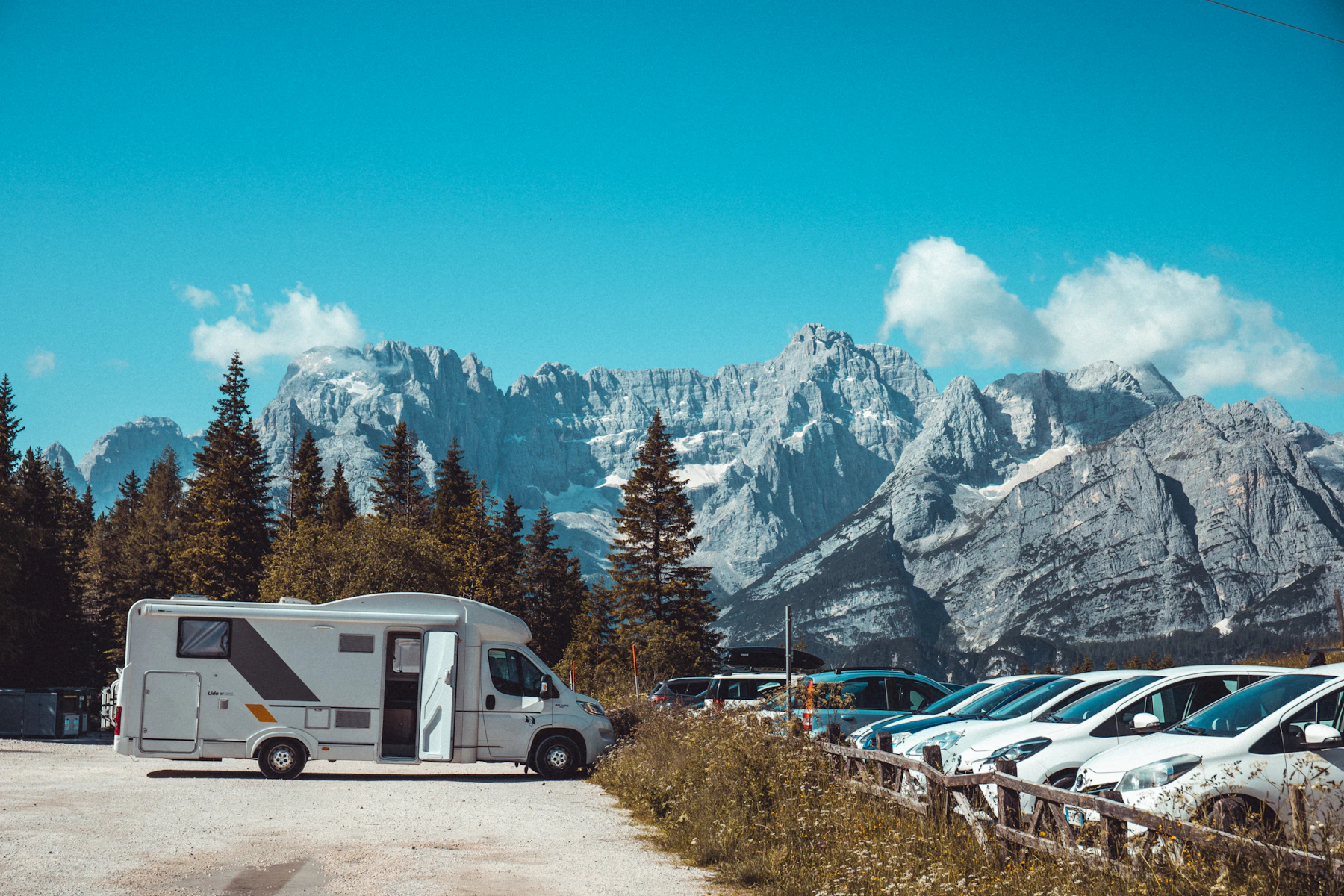
A Stellplatz is a place a German town has set aside for motorhomes to park overnight. The full word is Wohnmobilstellplatz, plural Stellplätze. It is a parking place with permission to sleep, not a campsite, and that one distinction explains almost every rule you will meet on one. Every price and rule below comes from the town’s own page, checked October 7, 2026.
Who runs them
Most are run by the town itself, the Gemeinde or Stadt, often on a car park beside the swimming pool, the spa or the river. Some belong to a winery, an inn or a private operator. Either way, the operator writes the rules and posts them on a board at the entrance.
How it differs from a French aire and a campsite
A French aire usually comes with a borne, the service post for water and waste, because servicing is part of what the word means. A Stellplatz promises less. Some have a full service point and a hook-up on every bay. Plenty are marked bays on gravel with a sign and nothing else. Toilets are rare, so assume you need your own.
A campsite (Campingplatz) has a reception, showers and room to spread out. A Stellplatz does not, and the towns say so in writing. Tirschenreuth’s Stellplatz ordinance states it outright: “Der Wohnmobilstellplatz ist kein Campingplatz.” It bans awnings, open fires, washing lines, and washing or showering outdoors. Berching’s rules ban “campingähnliches Verhalten”, camping-style behavior, along with generators and barbecues.
In practice: park, sleep, keep your things inside the van. If you want chairs out and the awning down for a week, book a campsite.
What they cost
The common German pattern is free to park, pay for services. Balingen charges nothing for its 7 bays at the Freibad, then 0.50 euros per kWh for electricity and 0.10 euros per 10 liters of water at a coin meter, with gray water disposal free.
Others charge for the night:
- Berching: 7 euros for 1 day, 14 for 2, 18 for 3, from a ticket machine. Water 1 euro, electricity 1 euro per kWh.
- Rastatt: 8 euros a night April to October, 5 euros November to March, plus a 15% operator fee. 3 nights maximum, and no water, power or disposal on site.
- Überlingen on the Bodensee: 18 euros per motorhome per 24 hours, 3 days maximum, vehicles up to 8 meters.
Carry 1 and 2 euro coins whatever the price, because the meters on the water and power posts usually take them.
The Kurtaxe
In spa and resort towns, expect a Kurtaxe, a visitor tax charged per person per day. Hausach in the Black Forest charges 10 euros per vehicle per night plus 2 euros Kurtaxe per adult per day, under 16s free. The Kurtaxe comes with a KONUS card, which covers buses and trains across the Black Forest. In Überlingen it is already inside the 18 euros, and Bad Säckingen charges 13 euros per 24 hours with electricity and the KONUS card included.
Ver- und Entsorgung
Ver- und Entsorgung is the service point: fresh water in, gray and black water out. Not every Stellplatz has one, and Rastatt is a reminder that a paid one may have nothing at all. Plan the service stop separately from the night’s stop. The dump station finder shows where you can empty your tanks.
How to read the board
The board at the entrance is the rulebook. The words to know:
- nur Wohnmobile: motorhomes only. Cars, caravans and tents are excluded at Berching and Tirschenreuth.
- autark: self-contained. Berching turns away vehicles without a toilet or a gray water tank.
- Höchstnutzungsdauer or maximal drei Nächte: the stay limit. Tirschenreuth allows 5 days, Rastatt 3 nights.
- Parkschein: a ticket from the machine, displayed behind the windshield. Berching says it checks.
- Nachtruhe 22 bis 6 Uhr: quiet hours.
- Kurtaxe: the per-person visitor tax.
Sleeping outside a Stellplatz
A car park is not a Stellplatz. Where sleeping in a vehicle on the street stops being parking and becomes camping is set by each Land’s road law and by the town, and the Germany page covers what is established. One federal rule applies directly: § 12 (3a) of the StVO bans regular overnight parking (22:00 to 06:00) for vehicles over 7.5 tonnes inside built-up areas in residential and spa districts. Most motorhomes are well under that, but not all.
The simplest night is the designated one. Browse the Stellplätze in Bavaria or the rest of the aires and stopovers hub, and whatever you plan, the board at the entrance and the Gemeinde’s current guidance beat any website, this one included.
Sources
- Stellplatzordnung Wohnmobilstellplatz der Stadt Berching, May 6, 2024
- Wohnmobilstellplatzbenutzungssatzung, Stadt Tirschenreuth, May 25, 2022
- Wohnmobilstellplätze, Stadt Balingen
- Städtische Wohnmobilstellplätze, Tourismus Rastatt
- Wohnmobilstellplatz, Stadt Hausach
- Reisemobilhafen Überlingen, Überlingen am Bodensee
- Wohnmobilstellplatz Am Rheinufer, Stadt Bad Säckingen
- § 12 Halten und Parken, Straßenverkehrs-Ordnung (StVO)
When a source is not in English, follow the link for the official wording.