

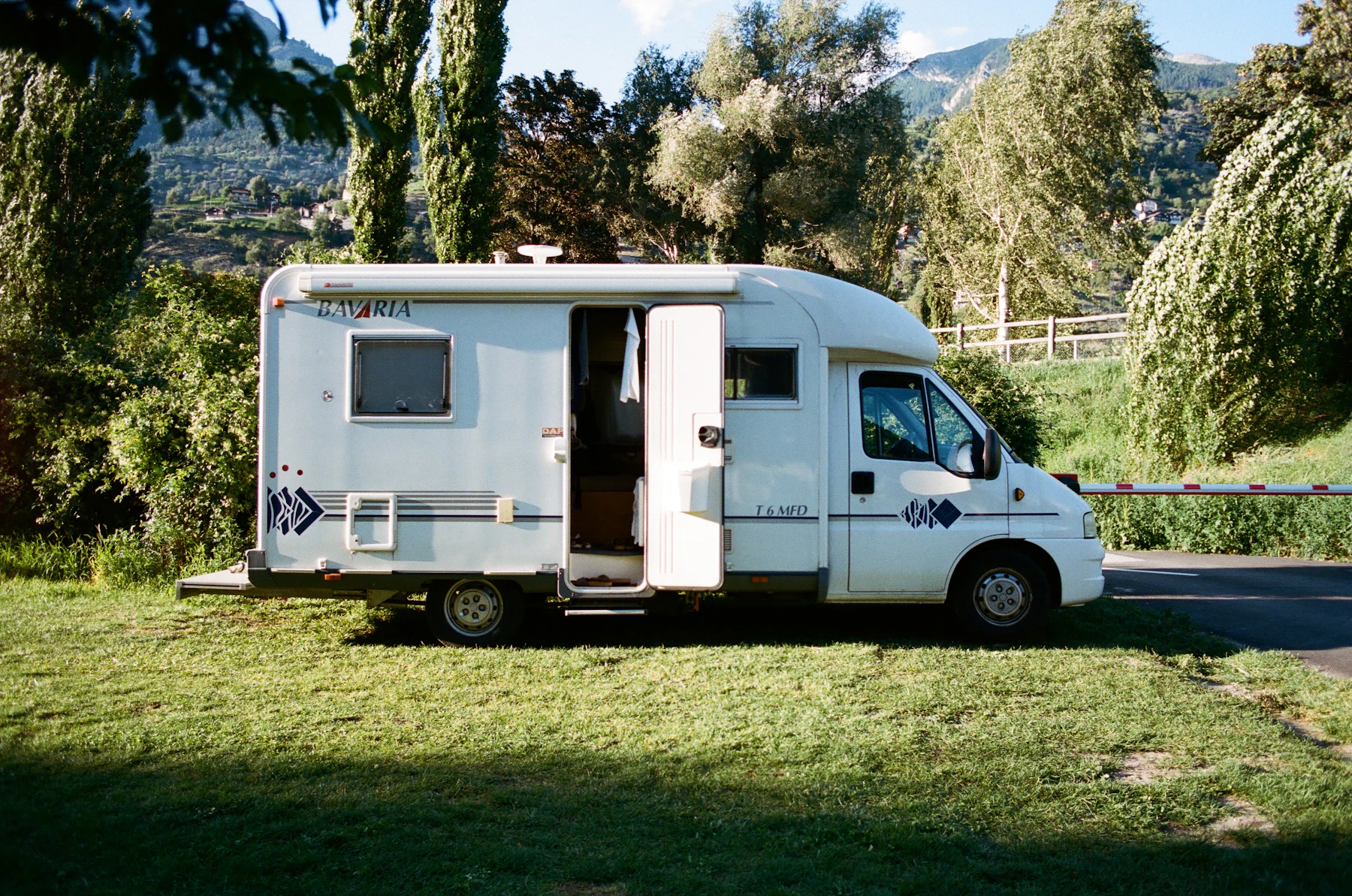
Wild camping in France is legal by default and banned by exception. The baseline is one sentence in the Code de l’urbanisme (the French planning code): you can camp off the road with the agreement of whoever has the use of the land. The exceptions are where people get fined: the coast, protected sites, the area around drinking-water sources, communes that ban it by local order, and the core zones of the national parks. In a van or motorhome, the question is different altogether. It is about parking.
The baseline: free, with permission
Article R111-32 of the Code de l’urbanisme reads:
Le camping est librement pratiqué, hors de l’emprise des routes et voies publiques, dans les conditions fixées par la présente sous-section, avec l’accord de celui qui a la jouissance du sol, sous réserve, le cas échéant, de l’opposition du propriétaire.
In plain English: camping is freely practiced, off roads and public highways, with the agreement of whoever has the use of the land, and the owner can object. The French text is the authority. Checked on Légifrance on October 12, 2026.
What that means on the ground: the field belongs to someone, and their yes is what makes your night legal. Ask the farmer and you are fine. This is not a Nordic right to roam. Pitching in a random field without asking is not what the article covers.
The bans that apply everywhere
Article R111-33 bans isolated camping, unless a dérogation (an exemption) has been granted, in four kinds of places:
- the seashore (rivages de la mer) and listed sites (sites inscrits);
- classified sites (sites classés), including those being classified;
- remarkable heritage sites and the surroundings of historic monuments;
- within 200 meters of a drinking-water source.
Checked on Légifrance on October 12, 2026. The coast is the one that catches most visitors. A tent on a French beach without an exemption is not allowed, on any coast, and this is not a gray area.
What the maire can add
Article R111-34 adds a local layer. The commune’s planning document (the plan local d’urbanisme) or an arrêté municipal (a local order signed by the maire, the mayor) can ban camping outside campsites in specific zones where it would harm public health, safety or peace, the landscape, natural habitats, or farming and forestry. The article then says these bans only apply once they are posted at the mairie (town hall) and signed at the usual access points. Checked on Légifrance on October 12, 2026.
So the sign at the access point is the rule. If there is one, it applies. If there is none and you are unsure, ask at the mairie.
Bivouac is not camping
The two words mean different things in France, and the difference matters most in national parks. The national parks portal defines a bivouac as a single night in a minimal setup, under the stars or in a compact tent. Camping sauvage, wild camping proper, is strictly banned in the park cores.
- Bivouac is tolerated in the cores within each park’s hours, for example 7 p.m. to 9 a.m. in the Écrins, Mercantour, Pyrénées and Cévennes.
- It is banned outright in the cores of Port-Cros, Porquerolles and the Calanques.
- It is on foot only. Cars, motorhomes and vans are excluded.
Checked on October 12, 2026. Park-by-park hours are on our France bivouac rules page.
In a van or motorhome: it is a parking question
The freedom in R111-32 explicitly stops at roads and public highways. Sleeping in a motorhome on a parking lot is therefore about parking, and the maire regulates that: Article L. 2213-2 of the Code général des collectivités territoriales lets the maire ban or restrict parking for certain vehicles by reasoned arrêté. In a March 26, 2020 answer to the Senate, the government said that, outside exceptional local circumstances, such a ban cannot be general and absolute, meaning it cannot cover every road in the commune permanently. Checked October 12, 2026.
In practice: a single lot with a no-motorhomes sign is perfectly lawful, and the sign applies. On an ordinary lot, stay on your wheels with nothing set up outside, and treat a height barrier at the entrance as the answer it is. The easy option is an aire, a stopover a French commune has set aside for motorhomes. Many are free, and whether you may sleep there is already settled. Find them on the France page, and see a route built around them in our free camping France itinerary.
The sign wins
In France this is close to written into the law: a commune’s camping ban only applies once it is posted. That makes the sign at the site the most current rule you will get. If it disagrees with this page, the sign is right.
Sources
- Article R111-32, Code de l'urbanisme, Légifrance
- Article R111-33, Code de l'urbanisme, Légifrance
- Code de l'urbanisme, Camping (Articles R111-32 to R111-35), Légifrance
- Le bivouac, Portail des parcs nationaux de France
- Stationnement des camping-cars, written question no. 14376, government answer, JO Sénat, March 26, 2020
When a source is not in English, follow the link for the official wording.