

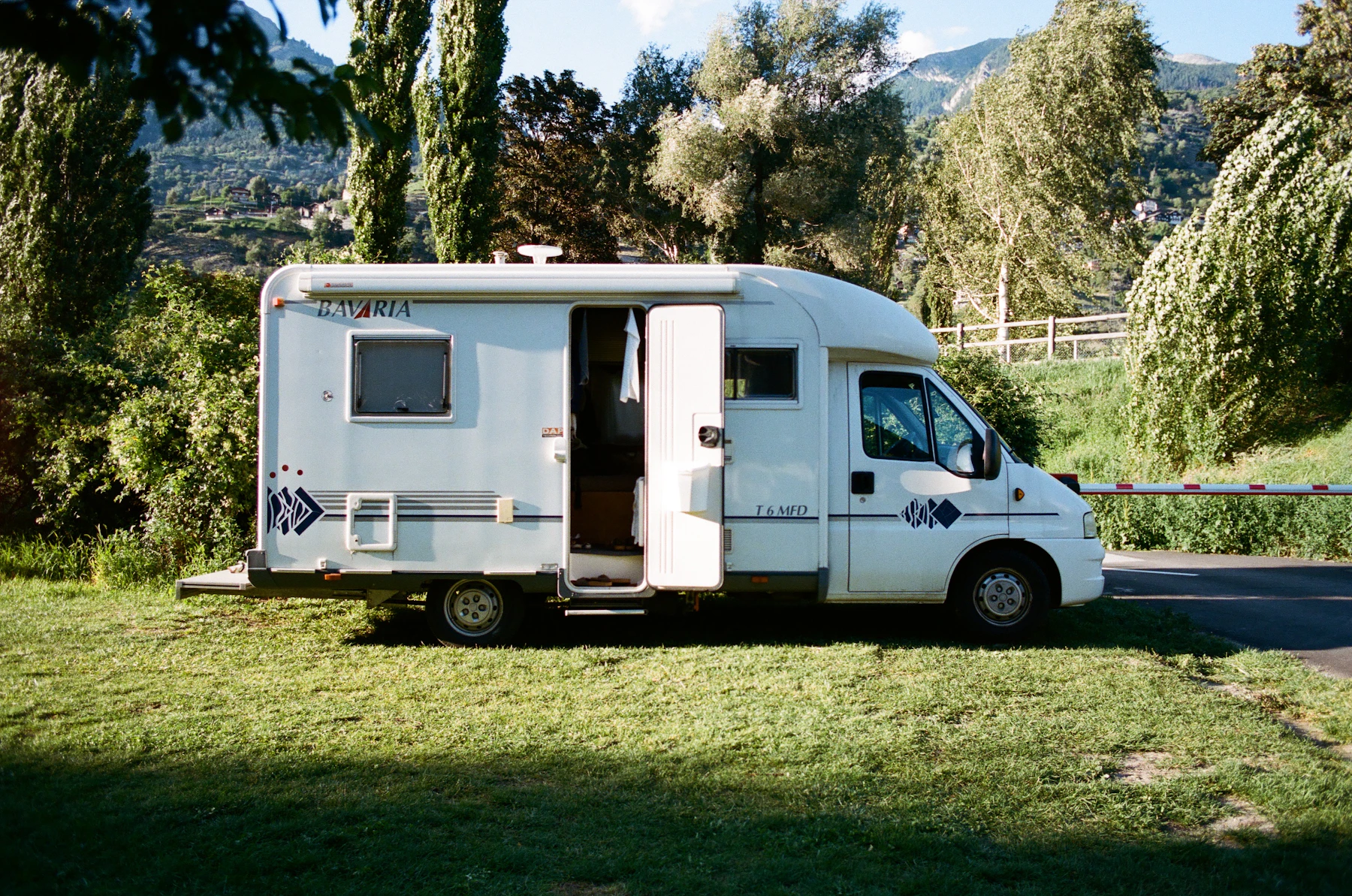
A van has three separate problems, not one. Fresh water in. Gray water out. Toilet waste out. They have different sources, different disposal points and different rules, and the single most common beginner error is treating them as one errand called “services”.
This page is written for a vehicle that does not have a service hookup: no campsite pitch, no electric bollard, no drain under the wheels. The machinery itself, the borne and the jetons that run it, is covered separately on service points. Read that for how the plumbing works. Read this for what to do when there is no borne in front of you.
1. Fresh water: where it comes from
Ranked by how likely it is to be both legal and drinkable.
A service point on an aire, Stellplatz or sosta. The designed answer. Usually a tap on the borne marked eau potable, often on a token or a coin, sometimes metered by volume. Bénéjacq’s commune page and Anor’s both describe their bornes this way, with tokens sold in town. See service points for the mechanics and what is an aire for how the stopovers work.
A campsite. Reception can usually sell you water and emptying without a night, and municipal campsites are generally more willing than commercial ones. It is a per-site decision, so ask.
Filling stations. Some have a motorhome service point, particularly on main routes and in Spain and Portugal. Many have only an air and water point for radiators, which is not necessarily potable. Ask inside.
Public fountains and municipal taps. Where a town provides one it is normally marked. Filling a 100 liter tank from a village fountain, slowly, with a queue behind you, is how a fountain acquires a sign banning it.
Marinas, sports grounds, cemeteries and other people’s taps. All of these get used and all of them are somebody’s water. Cemetery taps in France deserve their own sentence because they come up constantly: they are provided for watering graves, the water is frequently unmarked as to potability, and communes have acted to restrict access after motorhomes used them. It is a place of burial, it is not a service point, and every other answer on this list is better.
In Spain, look for the sign. The DGT’s Instrucción PROT 2026/04 records the S-128 punto de vaciado de caravanas y autocaravanas, in the vertical sign catalogue approved by Real Decreto 465/2025 of 10 June, marking the location of a waste water disposal point for caravans and motorhomes. That marks emptying rather than filling, but sites that have one usually have the other.
2. Potable or not: the sign is the whole answer
Learn the pairs. You will meet them on a metal plate, not in an app.
- French: eau potable is drinking water. eau non potable is not.
- German: Trinkwasser is drinking water. Kein Trinkwasser is not.
- Italian: acqua potabile and acqua non potabile.
- Spanish: agua potable and agua no potable.
- Dutch: drinkwater and geen drinkwater.
- Portuguese: água potável and água não potável.
Three rules that follow from this.
An unmarked tap is not a drinking tap. Treat it as non-potable if you are filling a drinking tank, and use it for the cassette and the bay instead.
Non-potable taps at service points are there on purpose. They are for rinsing the toilet cassette and washing the bay down, and they are sometimes a meter from the drinking tap on the same post. Read before you connect.
Carry a dedicated hose. A food-grade drinking water hose that never touches the cassette-rinse tap, kept in its own bag, with the ends capped. The hose is the part that contaminates a clean tank, not the tap.
3. Gray water is not harmless
Gray water is everything that goes down the sink and the shower: food particles, cooking grease, detergent, skin. It leaves warm and it starts to smell within a day of hitting the ground.
Where it can go. Into a disposal point built for it. That is a floor grating on a service bay connected to the foul sewer, or a campsite’s dedicated drain.
Where it cannot go. Italy’s article 185 of the Codice della Strada is the clearest national statement of it: discharging organic residues and acque chiare e luride, clear and dirty waters, onto roads and public areas outside a proper sanitary disposal installation is prohibited, with an administrative fine of 87 to 344 euros. VINCI Autoroutes puts the same rule for its network in a single line: “Il est interdit de vidanger sur la voie publique, dans la nature ou dans les bouches d’évacuation des eaux de pluie.” It is forbidden to empty onto the public highway, into nature, or into rainwater drains.
The storm drain is the trap. A gutter grating in a car park usually goes straight to a watercourse without treatment. It looks exactly like the thing you are supposed to use, and it is the opposite. A foul drain is on a service bay, signed, and normally has a hinged lid or a grating built into a concrete apron you are meant to park over. If you cannot tell which one you are looking at, you have your answer.
Why this is the rule that closes stopovers. A commune installs an aire, people tip gray water onto the gravel because the drain was 40 meters away, the bay smells by August, residents complain, and the aire gets a barrier. Every restriction on this site’s map started as somebody’s convenience.
The habit that avoids it. Empty at the service point on the way in or on the way out, deliberately, as its own task. Do not carry a full gray tank for two days because you were “going to find somewhere”.
4. Chemical toilet waste is a different problem
Cassette waste is sewage plus, in most systems, a chemical additive. It is not gray water and it does not go in the same place.
The dedicated point. A service area normally has a smaller, separate point for the cassette, often a low bowl with a lid and its own rinse tap, sometimes signed with a WC pictogram. That is where it goes. Use the rinse tap, which is non-potable, and never the drinking tap.
Campsite chemical disposal. Every campsite with a sanitary block has one, and this is one of the reasons to book the occasional night.
Public toilets. A public WC connected to the foul sewer can take cassette waste where the operator permits it, and plenty do not. Ask rather than assume, and do not empty a cassette into a squat toilet, a bowl without a proper flush, or anything with a macerator.
What never works. A storm drain. A hedge. A field. A roadside. A campsite shower drain. Article 185 covers organic residues explicitly, and the fine attaches to the act rather than to the volume.
Additives. Some sites ask for biologically degradable additives only, because the waste goes to a small treatment works or a septic system that strong formaldehyde-based products upset. That is a per-site rule and it is posted at the point, so read the sign on the bay and buy the additive the sites on your route will accept.
5. Winter changes everything
Water is the first thing a European town switches off in the cold.
Two separate things happen. Bornes get drained. Municipal service pillars are commonly put into frost protection over the winter so the internal circuits do not freeze and split, which means the pillar is standing there and the water does not come out. Sites close for the season entirely. Sainte-Eulalie-en-Born, in the Landes, states that its aire is open 1 April to 30 October, which is a normal shape for a seasonal municipal site and not an unusually short one.
The dates vary by commune, by altitude and by year, so the ones you read elsewhere will not be the ones on the gate in front of you. What travels is the habit:
- From roughly November to March, fill when you can rather than when you need to.
- Assume the small rural aire has no water and plan the fill at a campsite, a filling station or a larger town.
- Check the commune’s own page before you route a day around a specific borne.
- Freezing also affects your own vehicle. A full external tank and a full waste tank both freeze, and a frozen waste tank does not empty when you finally reach a drain.
6. What good practice actually looks like
The whole of the above compressed into the order you do it in.
- Empty the toilet cassette at the dedicated point.
- Empty gray water at the drain, over the grating, not beside it.
- Rinse with the non-potable tap. Leave the bay as you found it.
- Move to the fresh water tap, connect the clean hose, fill.
- Do all four as one deliberate stop, in daylight, before you need any of it.
And the thing that keeps stopovers open: nothing goes on the ground, ever, and the next vehicle should not be able to tell you were there.
Where a source is in French, Italian or Spanish, the original is the authority and our English is a summary of it. The posted sign at the service point and the commune’s current rules beat this page.
Related
- Service points: the borne, the jetons, the machinery and how to pay for it.
- What is an aire: the stopover network these service points sit on.
- Showers on the road in Europe: where the water goes before it becomes gray water.
- Motorhome travel in Europe: tolls, gas, height barriers and the rest of the planning.
Sources
- Articolo 185, Codice della Strada (Circolazione e sosta delle autocaravan), ACI
- Camping-cars: reussir votre pause sur autoroute, VINCI Autoroutes
- Instruccion PROT 2026/04 Autocaravanas, Direccion General de Trafico (Spain), signed 11 March 2026
- Aire de camping-cars, Commune de Sainte-Eulalie-en-Born
- Borne camping-car, Commune de Benejacq
- Notre aire d'accueil de camping-car, Ville d'Anor
When a source is not in English, follow the link for the official wording.